


Ergün Numan
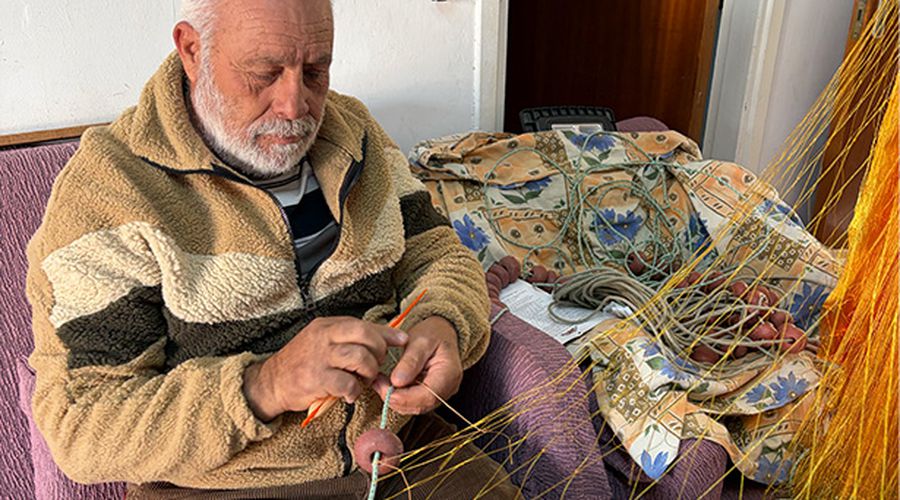
Ergün Numan was born in Nicosia in 1959 and lived in Günebakan until the age of 15. He completed his secondary education in Yeşilırmak. After high school, he completed his military service and began working as a fisherman in 1983, a practice he continues to this day.
In 1985, he started working as a firefighter, serving 13 years as a private and 13 years as a sergeant before completing his career as a chief officer. Throughout these years, he continued fishing alongside his firefighting duties. His fishing journey began when his father purchased a boat, which he later sold to acquire a larger one. For many years, he fished with his friend Refik Yalçıntaş, whom he considers his mentor.
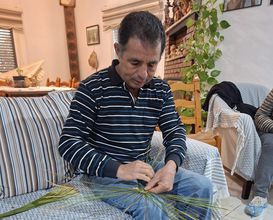
In the past, the nets they used were woven by a woman known as Neriman Abla. Over time, they decided to make their own nets. Ergün Numan learned net rigging from his master Ömer and later passed this knowledge on to his wife and three daughters. While many fishermen and net makers once practised this craft, today only one or two remain.
He explains that net making begins with determining the net’s measurements. First, the number of meshes is decided, followed by calculating the overall size. Measurements are typically based on half the length of three meshes. In fishing nets, mesh size refers to the distance between two opposing knots, or the opening of a single mesh loop.
Nets can be made as single-layer or double-layer structures. Single-layer nets are known as “bare nets/ çıplak ağ”, while double-layer nets are referred to as “trammel nets / fanyalı”, which allow fish to be pocketed within the net. Different mesh thicknesses and layer counts are used for different fish species. Single-layer nets are generally used for fish over one kilogram, and the thickness of the fishing line plays a crucial role in successful fishing.
Each species requires a specific type of net. Red mullet nets are trammel nets, usually consisting of two or three layers with a central inner panel. Vopa nets typically have mesh sizes of 18 mm or smaller, while izmarit nets use 17 mm mesh. According to Ergün, trammel nets are the most delicate and do not tolerate errors during construction, as corrections are extremely difficult.
In net making, floats (fello) are buoyant elements attached to the upper edge of the net at evenly calculated intervals to keep it properly positioned in the water. The headline (head rope) runs along the upper and lower edges of the net and serves as the main supporting rope to which the mesh, floats, and sinkers are attached. Sinkers, sewn onto the lower edge, pull the net downward; as much as they pull down, the floats pull up. If this balance is not achieved, the net collapses in the water and loses its function.
Since 2015, Ergün Numan has served as President of the Fishermen’s Union. He describes the meaning of his work simply:
“The sea means peace; it is a place where one can clear the mind.”
This account highlights fishing net making as a highly precise craft, requiring careful calculation, balance, and skilled workmanship.
Similar Artisan List
Project was funded by European Union. Project’s main goal is to promote stronger participation of youth in reconciliation and peace processes for reunification of Cyprus, as well as raise awareness of the shared cultural heritage of the two communities.
Helpful Links
Contact Us


